


Foundation concerns are one of the most common reasons homeowners across Northwest Arkansas call us about tree removal. The anxiety is understandable — foundation repair costs can easily reach $10,000-$30,000 or more, and the idea that a tree’s roots might be slowly destroying your home’s structural integrity is legitimately concerning. We field these calls regularly, and the conversation usually starts with some version of: “I have a large tree near my house, and I’m worried about the roots.”
Here’s what we’ve learned from years of dealing with these situations: tree root damage to foundations is real, but it’s also frequently misunderstood. Not all trees near houses pose foundation risks. Not all foundation cracks are caused by trees. And in many cases, the relationship between trees and foundations is more nuanced than “tree near house equals foundation damage.” Understanding the actual mechanisms of root damage, which trees and situations pose genuine risks, and what warning signs to watch for helps property owners make informed decisions rather than removing trees unnecessarily or ignoring real problems until they become expensive.
This guide breaks down what actually happens when tree roots interact with foundations, which Northwest Arkansas tree species pose the highest risks, and how to evaluate whether the trees on your property are problems waiting to happen or perfectly fine where they are.
Key Takeaways
- Tree roots rarely break intact foundations but can exploit and widen existing cracks through pressure and moisture extraction
- Clay soils in Northwest Arkansas are particularly vulnerable to root-related foundation movement due to shrink-swell behavior
- Species matters significantly — willow, silver maple, and poplar are high-risk; oak and most conifers are lower-risk
- Trees planted within 10-20 feet of foundations (depending on mature size) warrant closer monitoring
- Warning signs include progressive foundation cracks, sticking doors/windows, and visible root growth near the foundation
- Prevention through proper species selection and placement is far more cost-effective than dealing with established problem trees
How Tree Roots Actually Affect Foundations
The popular image of tree roots physically breaking through concrete foundations like some kind of botanical battering ram doesn’t match what actually happens in most cases. Roots don’t typically have the force to break intact, structurally sound concrete. What they do instead is exploit existing weaknesses and create conditions that allow foundation problems to develop or worsen.
Moisture extraction is the primary mechanism of root-related foundation damage, particularly in Northwest Arkansas where many properties sit on clay soils. Clay expands when wet and contracts when dry. Tree roots extract significant moisture from the soil during the growing season, causing clay soil to shrink. This shrinkage creates voids or allows soil to pull away from the foundation. When the soil contracts unevenly — more on the side with the tree roots than the other side — differential movement occurs. This movement creates stress on the foundation that manifests as cracks, settling, or shifting.
We see this pattern most clearly during drought years. A tree that’s been fine for decades suddenly correlates with foundation cracks during an extended dry period when the tree is pulling every bit of available moisture from the soil to survive. The tree didn’t suddenly become aggressive — the moisture stress intensified what roots naturally do.
Physical pressure from growing roots is the secondary mechanism. Roots that grow along or under a foundation can create pressure points as they expand in diameter. This matters most for roots that get into existing cracks or gaps. A root that finds its way into a hairline crack will absolutely widen that crack over time as the root grows. What started as a minor, cosmetic crack can become a structural concern once roots establish inside it.
Soil displacement happens when large root systems develop under or immediately adjacent to foundations, particularly shallow foundations or slab-on-grade construction. The roots themselves occupy space, which can shift or lift soil and, in extreme cases, the foundation itself. This is less common than moisture-related issues but does occur with aggressive root systems in certain soil types.
Northwest Arkansas Soil Conditions and Foundation Vulnerability
| Soil Type | Foundation Risk Level | Why It Matters | Common NWA Locations |
|---|---|---|---|
| Expansive clay | High | Significant shrink-swell movement | Bentonville, Rogers, Springdale areas |
| Clay loam | Moderate-High | Some expansion/contraction | Mixed throughout region |
| Sandy loam | Low-Moderate | Minimal movement but less support | River valleys, some rural areas |
| Rocky/shallow soil | Low | Limited root penetration depth | Ozark hillsides, rocky terrain |
| Well-drained soil | Low | Stable moisture levels reduce movement | Best-case scenario when available |
Northwest Arkansas sits in a region where clay soils are common, and this matters significantly for root-related foundation concerns. Clay soils are particularly susceptible to moisture-driven volume changes. A clay soil profile can shrink several inches vertically during severe drought, creating substantial gaps between soil and foundation. When rain returns and the clay re-expands, that movement cycle stresses foundations repeatedly over time.
Properties in Bentonville, Rogers, and Springdale frequently have clay-heavy soils that show this expansive behavior. We work with homeowners in these areas regularly who are dealing with foundation movement issues, and tree root moisture extraction is often a contributing factor — though rarely the only factor. Poor drainage, plumbing leaks, and natural soil settlement all play roles.
The practical implication is that the same tree species at the same distance from a foundation creates different risk levels depending on soil type. A silver maple 15 feet from a house on sandy, well-drained soil might be perfectly fine. The same tree at the same distance on expansive clay could be contributing to foundation problems within 10-15 years. Soil type matters as much as tree species when evaluating risk.
High-Risk Tree Species for Foundation Damage
Certain tree species are substantially more likely to cause foundation issues than others, primarily due to aggressive, shallow root systems and high water demands. If you have these species near your foundation, they warrant closer attention and possibly proactive removal before problems develop.
Willow species (weeping willow, black willow) top the list. Willows are adapted to grow near water sources, which means their root systems are specifically evolved to seek out moisture aggressively. They develop extensive, shallow root systems that spread far from the trunk. A mature willow can have roots extending 50+ feet from the trunk, all actively seeking moisture. Combined with their preference for wet conditions, willows near foundations create predictable problems in clay soils.
Silver maple appears on this list as well as the storm damage list for good reason — they’re problematic trees in multiple ways. Silver maples grow fast and develop large, aggressive root systems. They’re not as water-seeking as willows, but their roots are shallow, extensive, and vigorous. We remove silver maples for foundation concerns regularly, particularly those planted 10-15 feet from houses in the 1970s-1990s before people understood the long-term issues.
Poplar and cottonwood species have similar characteristics to willows — fast growth, aggressive roots, high water demand. They’re less commonly planted near houses intentionally, but sometimes volunteer from seeds or were planted decades ago. If you have a large poplar near your foundation, that’s a legitimate concern worth evaluating.
Elm species can develop aggressive root systems, particularly American elm. While not as problematic as willows or silver maples, mature elms near foundations do warrant monitoring, especially on clay soils during drought periods.
Oak species are generally lower risk despite growing large, because their root systems tend to grow deeper rather than shallow and spreading. However, very large, mature oaks with roots that have been growing for 50+ years can still create issues through sheer size and moisture demand. The key difference is that oaks are far less likely to cause problems than the species listed above.
Lower-Risk Trees and Smart Planting Decisions
If you’re planning new plantings or replacing removed trees, species selection matters enormously for avoiding future foundation issues. These species are substantially less likely to create problems when planted at appropriate distances from structures.
Most conifers (pines, spruce, fir, cedar) develop root systems that are relatively compact and deep compared to the aggressive spreading roots of willows and maples. While they still need proper setback from foundations, they’re much lower-risk choices for properties where shade trees near the house are desired.
Smaller ornamental trees (dogwood, redbud, crabapple, serviceberry) stay small enough that their root systems never develop the size or water demand to create foundation issues. These are excellent choices for locations relatively close to houses where larger trees would be problematic.
Slow-growing hardwoods (hickory, many oak species, black gum) develop more slowly and tend toward deeper root systems. While they still need appropriate placement, they’re lower-risk than fast-growing species.
The general rule we share with homeowners planning new trees: consider the mature size of the tree (both canopy and root system) and plant at a distance from the foundation equal to at least half that mature width, preferably the full width. A tree that will reach 40 feet wide at maturity should be planted 20-40 feet from your foundation. This provides adequate buffer for root development without creating long-term conflicts.
Safe Planting Distances by Tree Size
| Tree Mature Size | Minimum Distance from Foundation | Recommended Distance | Example Species |
|---|---|---|---|
| Small (< 25 ft) | 8-10 feet | 10-15 feet | Dogwood, redbud, crabapple |
| Medium (25-40 ft) | 15-20 feet | 20-30 feet | Smaller maples, birch, hornbeam |
| Large (40-60 ft) | 20-30 feet | 30-50 feet | Oak, hickory, larger maples |
| Very large (> 60 ft) | 30+ feet | 40-60 feet | Willow, cottonwood, large oak (if planted at all) |
These distances assume normal soil conditions. Increase distances by 25-50% for expansive clay soils or decrease slightly for sandy, well-drained soils. When in doubt, plant farther rather than closer — you can never have too much distance between trees and foundations, but you can easily have too little.
Warning Signs of Root-Related Foundation Problems
Catching potential issues early allows for intervention before major damage occurs. These are the specific warning signs we look for when assessing whether a tree might be contributing to foundation problems.
Progressive foundation cracks are the most obvious indicator. Not all foundation cracks indicate tree root problems — some settlement cracking is normal in the first few years after construction. What matters is progression. Cracks that widen over time, particularly during growing seasons or drought periods, suggest ongoing movement. Cracks that correlate with the location of nearby trees — heavier cracking on the side of the house nearest the tree — are especially suspicious.
Doors and windows that stick or don’t close properly indicate foundation movement that’s affecting the frame of the house. This often manifests as seasonal — doors that stick during summer (when trees are actively growing and extracting moisture) but work fine in winter. That seasonal pattern strongly suggests moisture-related foundation movement.
Visible root growth near or against the foundation is a red flag worth taking seriously. Surface roots running along the foundation or visible roots that appear to be growing under the foundation indicate the root system is actively interacting with the structure. This doesn’t automatically mean damage is occurring, but it means the conditions for future damage exist.
Gaps between soil and foundation that appear during dry periods and close when rain returns indicate shrink-swell soil movement. If you have trees nearby, they’re likely contributing to the moisture extraction that’s driving this movement. Repeated cycles of this movement stress foundations over time.
Plumbing issues can sometimes correlate with root problems. Tree roots seeking moisture can infiltrate sewer lines, which can lead to slow drains, gurgling, or backups. While this isn’t direct foundation damage, it indicates aggressive root activity near your home’s infrastructure, which raises concerns about foundation interactions as well.
When Tree Removal Is Necessary vs. Manageable
Not every tree near a foundation needs removal, but some situations clearly warrant it. Understanding the difference helps avoid unnecessary tree loss while still protecting your foundation.
Clear removal scenarios:
- Trees planted within 10 feet of the foundation, particularly high-risk species
- Trees showing visible root growth against or under the foundation with documented progressive foundation damage
- Willows, silver maples, or poplars within 15 feet of structures on clay soils
- Situations where foundation repair has been recommended and tree roots are documented contributors
- Trees that are dying or in decline (losing the protective value without reducing the root-related risk)
Management rather than removal scenarios:
- Healthy trees at appropriate distances (20+ feet) showing no foundation issues
- Trees that provide significant property value where root barriers might be effective
- Situations where the foundation damage predates the tree’s planting (tree isn’t the cause)
- Lower-risk species at moderate distances without documented problems
The decision often comes down to risk tolerance and the tree’s value. A beautiful, healthy oak that’s 25 feet from your foundation and showing no issues after 30 years is probably fine to keep with monitoring. A silver maple that was planted 12 feet from the house and is now showing surface roots heading toward the foundation represents a risk most homeowners shouldn’t accept long-term.
Root Barriers and Prevention Strategies
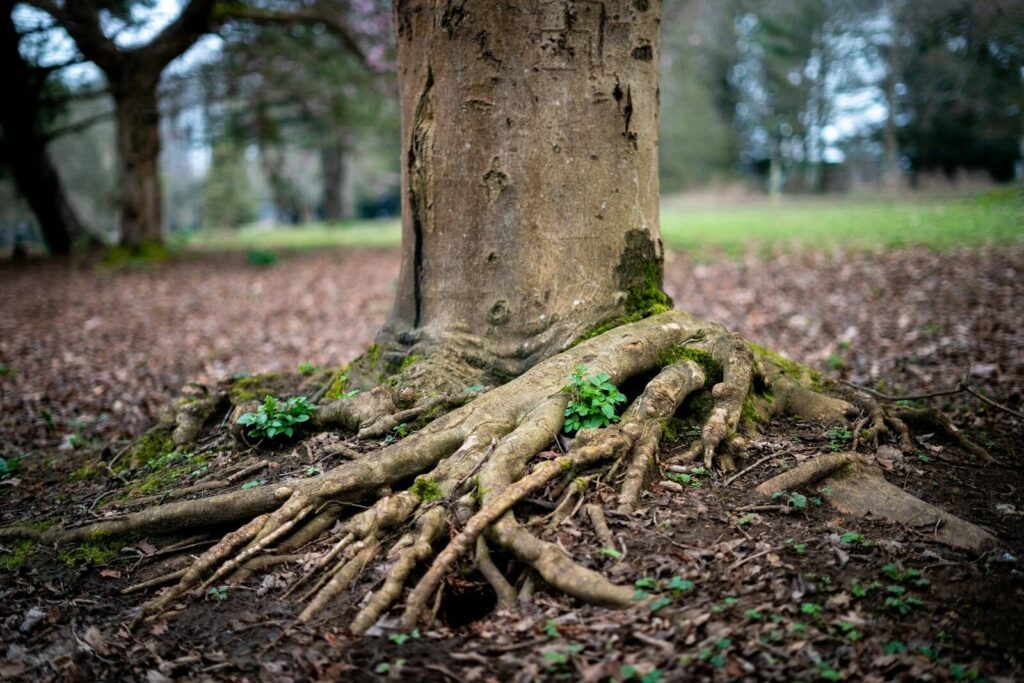
Root barriers are physical barriers installed vertically in the soil to redirect root growth away from foundations. They can be effective in the right situations, but they’re not universal solutions.
Modern root barriers are typically made of high-density polyethylene or polypropylene in sheets or panels that extend 18-36 inches deep. They’re installed between the tree and the foundation to create a physical obstacle that roots can’t penetrate. Roots encountering the barrier grow downward along it and then continue outward at greater depth, ideally below the foundation.
Root barriers work best when installed proactively — during or shortly after planting rather than years later when extensive root systems have already developed. Retrofit installation (adding barriers to existing trees) requires excavation that can damage roots and stress the tree. It’s possible but more complex and less effective than proactive installation.
The key limitation is that root barriers only redirect roots; they don’t eliminate them. If the barrier doesn’t extend deep enough or doesn’t cover enough area around the foundation, roots will simply go under or around it. A barrier that’s 24 inches deep does nothing to stop roots growing at 30 inches depth. Proper installation requires understanding the expected root depth and spread for the specific tree species.
For most homeowners, the cost-benefit analysis on root barriers favors simply planting trees at appropriate distances rather than planting too close and then trying to manage roots with barriers. However, for high-value trees in situations where some risk exists but removal isn’t desired, barriers can be a reasonable middle-ground approach.
What About Existing Trees Near Your Foundation?
If you’ve purchased a property with mature trees already near the foundation, or if you’ve been in your home long enough that trees you planted years ago are now mature and raising concerns, here’s how to evaluate the situation.
Document the current state. Take photos of the foundation from all sides, noting any existing cracks, their size, and locations. This baseline documentation allows you to monitor whether things are changing over time. Foundation cracks that are stable — not widening or lengthening — are far less concerning than progressive damage.
Monitor seasonally. Check the same areas during different seasons, particularly comparing late summer (when moisture extraction is highest) to late winter/early spring (when trees are dormant). Changes that correlate with seasons suggest moisture-related movement that may be tree-driven.
Consider the tree’s age and condition. A tree that’s been in place for 40 years without causing problems has likely established an equilibrium with the foundation. Removing it “just in case” might be unnecessary. However, a declining tree that’s losing canopy but maintaining active roots creates a worse situation — you lose the tree’s benefits while keeping the root-related risks.
Get professional assessment when uncertain. Both a structural engineer (for foundation evaluation) and a professional tree service (for tree evaluation) can provide expert opinions on whether the tree is actually causing or contributing to foundation issues. We work with foundation specialists regularly on these assessments and can often determine fairly clearly whether roots are the issue or if other factors are driving foundation movement.
Make decisions based on facts rather than fear. The internet is full of horror stories about tree roots destroying foundations, which creates anxiety that isn’t always justified by the actual risk. Not every tree near a house is a problem. Getting objective assessment helps separate real risks from hypothetical ones.
The Cost-Benefit Analysis
Deciding whether to remove a tree due to foundation concerns ultimately comes down to weighing costs, risks, and values. Here’s how we help homeowners think through this analysis.
Tree removal costs for mature trees near structures typically range from $1,500-$5,000 depending on size, access, and complexity. This is a known, predictable expense.
Foundation repair costs for root-related damage typically start at $3,000-$5,000 for minor repairs and can easily reach $15,000-$30,000 or more for significant issues requiring piering, mudjacking, or extensive structural work. This is a potential but not certain future expense.
Property value contribution from mature trees is real but variable. Studies show that quality landscape trees can add thousands to property values. A large, healthy tree in the right location is an asset. The same tree in the wrong location creating foundation concerns is a liability that reduces rather than enhances value.
The analysis for a high-risk tree close to the foundation — a willow 12 feet from the house on clay soil showing early foundation cracks — typically favors removal. The likelihood of expensive foundation issues developing is high enough to justify the removal cost, and the tree’s location makes it a liability for property value anyway.
The analysis for a lower-risk tree at moderate distance — an oak 25 feet from the house showing no issues after 20 years — typically favors keeping the tree with continued monitoring. The risk of foundation damage is relatively low, removal is expensive, and the tree provides real value where it stands.
FAQs
How close is too close for a tree to be planted near a foundation?
It depends on the tree’s mature size and species, but general guidelines are: small trees (< 25 ft mature) should be at least 10-15 feet away, medium trees (25-40 ft) at least 20-30 feet away, and large trees (40+ ft) at least 30-50 feet away. High-risk species like willows need even greater distances.
Can tree roots actually crack a solid concrete foundation?
Roots rarely break intact, structurally sound concrete. What they do is exploit existing hairline cracks, widening them over time, and extract moisture from clay soils causing foundation movement. The damage is usually indirect (movement and pressure) rather than direct breaking force.
I have a large tree that’s been near my house for 30 years with no problems. Should I still remove it?
Not necessarily. A tree that’s been in place for decades without causing issues has likely reached equilibrium with the foundation. However, monitor it for any changes — progressive foundation cracks, sticking doors, or visible root growth toward the foundation. If problems start developing after 30 years, they’re worth addressing, but stability over decades is generally a good sign.
Will cutting down the tree fix existing foundation damage?
Not directly. Removing the tree stops further root-related moisture extraction and pressure, but it doesn’t repair existing foundation damage. In some cases, removing the tree can actually cause short-term additional movement as soil moisture levels re-equilibrate. Foundation damage typically requires separate structural repair regardless of tree removal.
Are root barriers effective for protecting foundations?
Root barriers can be effective when installed correctly during or shortly after planting. They’re less effective when installed years later around mature trees with established root systems. Barriers redirect roots rather than eliminating them, so they must be deep enough and extensive enough to actually prevent root access to the foundation zone.
What should I plant instead of the tree I’m removing for foundation concerns?
Consider smaller ornamental trees (dogwood, redbud, serviceberry) that won’t develop large root systems, or plant larger trees at greater distances where they won’t threaten the foundation. Conifers are generally lower-risk than aggressive deciduous species. Work with a local nursery that understands NWA growing conditions and can recommend appropriate species.
How do I know if my foundation cracks are caused by tree roots or something else?
Foundation cracks have many potential causes — soil settlement, poor drainage, plumbing leaks, expansive soils, structural issues. Tree roots are one possibility but not the only one. Professional assessment from both a structural engineer (for the foundation) and a tree service (for the trees) can help determine the actual cause before you invest in unnecessary tree removal.
Get Professional Assessment for Foundation Concerns
If you’re dealing with foundation cracks and suspect tree roots might be involved, we provide honest assessments of whether trees are actually contributing to the problem. We work with foundation specialists regularly and can help you understand whether tree removal makes sense for your specific situation.
Schedule Your Foundation Risk Assessment | Call Now: 479-861-7497
Carlos Express Tree Service provides professional tree assessment and removal services throughout Northwest Arkansas, Southwest Missouri, and Northeast Oklahoma. Licensed. Insured. Bonded.


